7 Rs – Seven roads to take the right decision to move to the cloud

AWS (Amazon) , Azure (Microsoft) and GCP (Google) hyper-scale data centers are increasing their number during the last years in many regions supported by millions of investment in submarine cables to reduce latency. Southern Europe in not an exception. We can just take a look to Italy, Spain and France to realize what it´s happening.

Public cloud providers know many customers will move massively thousand of services in the coming years. The process just started some years ago. But due to the pandemic and the need to provide remote services, to analyse data quicker and with efficiency, the big expansion on sensors to measure almost all in our lives or a global market to beat the competitors in any continent with innovation, accelerates even more.

There are 7 Rs to take the right decision so the CIOs and CTOs know what make sense to move or not to the cloud. What is a priority and moreover the impact and effort to transform their business.

AWS perspective to move IT Services to the cloud

Move to the cloud with a clear perspective on outcomes and goals to achieve will be able to bring value to our customers if you evaluate with care each of your IT services so you can take decisions according with your business alignment. Some Applications could be retire other would enter in a cycle of modernization, other just resize to reduce cost and improve resilience..

Let´s explain our 7 Rs from simple to complex scenarios:

Retire. Some applications are not used any more. Just a couple of users need to do some queries from time to time. Hence maybe it´s better to move that old data to a data warehouse and retire the old application.

Retain. It means literally “do nothing at all”. May be this application use some API or backend from an on premise solution with some compliance limitations. May be it was recently upgraded and you want to amortize the investment for a while.

Repurchase. Here you have the opportunity to change the IT solution. Let´s say you are not happy with your firewall on premise and maybe you think it´s better to change to a different provider with a better firewall adoption for AWS or Azure, even to move from IaaS to SaaS some applications.

Relocate. For example, relocate the ESX hypervisor hosting your database and Web Services to VMware Cloud on AWS / Azure / GPC or move your legacy Citrix server with Windows 2008 R2 to a dedicated host on AWS.

Rehost. It means lift/shift. Move some VMs with clear dependence between them to the cloud just to provide better backup, cheaper replication on several regions and resize their compute consumption to reduce cost.

Replatform. Lift and optimize somehow your application. For instance, when you move your web services from a farm of VMs on Vmware with a HLB (Hardware Load Balancer) on premise to a external LB service on Azure with some APP Services where you can adopt the logic of your business and migrate your PhP or Java application. Therefore you don´t have to worry for Operating system patching or security at the Windows Server level anymore. Even eliminate the Windows operating license.

Refactor. The most complex scenario. You have a big monolithic database with lots of applications using that data, reading and writing heavily. You know, you need to move the applications and the monolithic database and modify its architecture by taking full advantage of cloud-native features to improve performance and scalability as well as to reduce risk. Any failure in a component provoke a general failure. Here you need to decouple your components and move to microservices sooner or later.

I hope you could understand better those strategies to move to the cloud your applications, so you can be laser focus on your needs and achieve the best approach for each of them.

To sum up use the right tools to evaluate your applications/ IT Services on premise and based on the 7Rs choose the suitable journey to the cloud for them..

Don´t forget to leverage all the potential of the CAF (Cloud Adoption Framework) https://wordpress.com/post/cloudvisioneers.com/287 that i´ve mentioned before in my blog together with the 7Rs strategy.


Enjoy the journey to the cloud with me…see you soon.
Containerization to become the RockStar on the stage

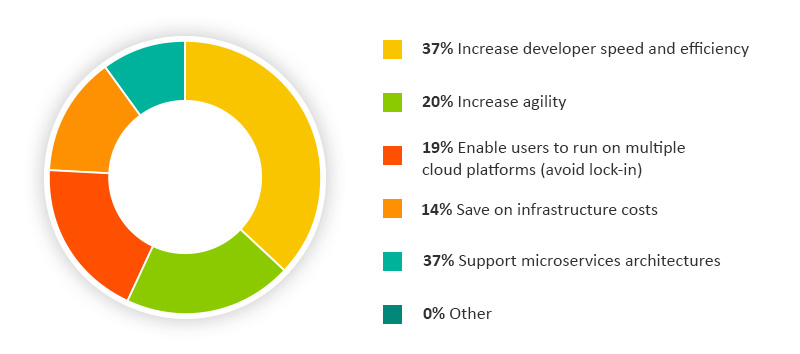
CNFC (Cloud Native Computing Foundation) can´t be more clear on their 2020 survey report:

The use of containers in production has increased to 92%, up from 84% last year, and up 300% from our first survey in 2016. Moreover, Kubernetes use in production has increased to 83%, up from 78% last year.

Related to the usage of cloud native tools there are also some clear tendences:
• 82% of respondents use CI/CD pipelines in production.
• 30% of respondents use serverless technologies in production.
• 27% of respondents use a service mesh in production, a 50% increase over last year.
• 55% of respondents use stateful applications in containers in production
.

What happens when someone adopts containers just for testing in their company?…in less than 2 years the containers are adopted in pre-production and production as well.

Why containerization is so extended?

Here are some facts i figure out.

Devops friendly – Well, there are some reasons, clear as water .. Almost all the big companies within the enterprise segment have a devops CI/CD strategy already deployed..so they´ve realised that integrating the builds and delivery versions with containers it´s quite agile and effective to compare those software last versions with several libraries as the runtime can be isolated easily and doesn´t depend on a operating system. So to summarize you can have quite quick several pods with containers ready to test two or three versions of your products with their libraries and plugins, packet managers or several artifacts depending on the version and test features, UX, bugs or just performance.. All aligned with your preferred repository solution: Bitbucket, Git, Github, etc.

Multicloud – Another fact and quite solid, it´s Kubernetes run on any cloud, private or public and you can orchestrate clusters with nodes wherever you want, without limitations on storage, compute or locations. Even you have at your disposal a great number of tools to orchestrate containers, not just Kubernetes but also Docker Swarm. To conclude, you can see bellow Docker as simple container runtime which was a tendency in RightScale 2019 survey. Now ,and that´s how technology change from one day to the next, Docker as an underlying runtime is being deprecated in favor of runtimes that use the Container Runtime Interface (CRI) created for Kubernetes. … Anyway, Docker is still a useful tool for building containers.

Cost Savings -You can roll out Microservices on demand and without investing a euro on hardware if you want a pure cloud solution. Just create your pads or simple containers and kill them when you want. Pay as you go, pure OPEX. That means reduce CAPEX on hardware and licenses and forget amortization.

Remove your Legacy applications on your on pace – Also, on one hand, big companies want to reduce legacy applications as they need to eliminate monolithic applications, which use to be very critical, with old versions software and dependences on hardware and licences and poor performance and scalability. On the other hand, they are compromise more than ever with the “Cloud first” principle for new IT services because they need to be global, reduce cost and improve resiliency and many CIOs know that public cloud bring those advantages from scratch.

Security – Least but not less. Containerization reduce the expose surface of your applications, eliminate any operating system bug, and allow to take control on known library vulnerabilities with your Software Quality team and your CISO. Networking is also an area where you can watch out the bad guys as traffic is flowing in and out of the containers and you can configure with granularity what is allowed and what not. Finally, you can monitorice the whole microservices solution with open source tools, cloud providers integrated tools or more veteran thirty party solutions.

In the next post we will see differences and similarities between AKS and EKS.

Enjoy the journey to the cloud with me…see you then in the next post.

Azure Synapse: A new kid on the Block. Empower you company Big Data and Analytics

Some years ago, an investment to analyze data was quite expensive in terms of hardware, networking, knowledge and skills usually external to the organization and obviously data center facilities. Nowadays you can enjoy cloud native data analytics tools that can be deployed in minutes in any region of the world. This cutting edge technologies are evolving to work better together as evolves a music orchestra when musicians and the conductor know each other better. He can give then a splendid performance in the concert. So happens in the cloud, the maturity of the native tools lets you decouple components so that they run and scale independently.

But why Big Data on prem is called to extinction?. Well, it is a matter of being cost-effective in middle-terms. There are some factors that have a great impact on CIOs and CFOs to change their minds:

Big Data on premise is rigid and inelastic as the capacity planning done by the architects to build those solutions is based on picks and needs to take into account the worst cases in performance. They can not scale on demand and if you need more resources you have to wait till they are available even weeks. On the other hand, you have a technical debt if you are underutilize your Big data infrastructure.

Big Data and Data analytics platforms on premise requires a lot skills and knowledge in place from Storage, to networking, from data engineering to data science. It is complex to maintain and upgrade. What is prone to failures and low productivity.

Data and AI&ML live in separate worlds in an on premise infrastructure. Two silos that you need to interconnect. Something that doesn’t happen on the cloud.


Move to the next level. Azure Synapse

Azure Synapse is a whole orchestra prepare to give a splendid performance in the concert. It is the evolution of Azure Data Warehouse as joins enterprise data warehousing with Big Data analytics.

It unifies data ingestion, preparation & transformation of data . So companies can combine and serve enterprise data on-demand for BI and AI/ML. It supports two types of analytics runtimes – SQL and Spark based that can process data in a batch, streaming, and interactive manner. For a Data Science is great because supports a number of languages like SQL, Python, .NET, Java, Scala, and R that are typically used by analytic workloads. You don’t have to worry for escalation, you has a virtually unlimited scale to support analytics workloads.

Deploy Azure Synapse in minutes – Using Azure Quick-Start templates it is possible to deploy your data analytics platform in minutes..choose 201-sql-data-warehouse-transparent-encryption-create to do so synchronize with your Repo on Azure devops and start to configure your deployment strategy.

Ingesting and Processing Data enhacements- Data from several origins can be load to the SQL pool component on Azure Synapse. Let’s say the old data warehouse. To load that data we can use a storage account or even better a data lake storage with the help of polybase, we can use other Azure component called Azure Data factory to bring data from several origins or traditional ones like BCP for those working with SQL. After cleaning the data on staging tables you can proceed to copy to production all that make senses.

A great advantage is that you can now get rich insights on your operational data in near real-time, using Azure Synapse Link. ETL-based systems tend to have higher latency for analyzing your operational data, due to many layers needed to extract, transform and load the operational data. With native integration of Azure Cosmos DB analytical store with Azure Synapse Analytics, you can analyze operational data in near real-time enabling new business scenarios.

Querying Data – You can uses Massive Parallel Processing (MPP) to run queries across petabytes of data quickly. Data Engineers can use the familiar Transact-SQL to query the contents of a data warehouse in Azure Synapse Analytics as well as developers can use Python, Scala and R against the Spark engine. There is also support for .Net and Java.

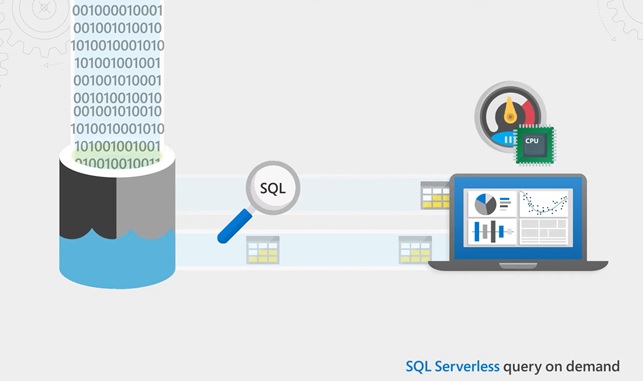
Moreover now it is possible to query on demand…

Authentication and Security – Azure Synapse Analytics supports both SQL Server authentication as well as Azure Active Directory. Also you can configure a RBAC strategy to access data with less privileged principals.

Finally, even you can implement MFA to protect your data and operational work.

In the next post, i will show you how work other pieces and components of Data Cloud solutions and the great benefits they bring in cost-savings and technical advantages..

See you them…

Agrotech – A new revolution is coming to Europe´s farmlands and crop zones..

Where is the opportunity?

There are large areas of land dedicated to the same crop which means an increased risk to pests and greater efforts in the fight against them. There are many plantations of corn, vines, fruit trees or simply cereals where the soils support a tremendous demand in giving the appropriate results to the farmers and growers. In the case of Spain, southern areas such as Almería produce tons of vegetables, fruits, plants of all kinds with significant water pressure since they are places where there is little rain.

Adding to that. we are facing significant rural depopulation in countries such as Italy, Spain, Portugal, France and further east Europe like Romania, Bulgaria, etc. Older people are left alone in rural settings. Moreover, young people are less and less present in those small villages and medium-sized towns surrounded by a lot of farmland.

We need an urgent answer and it is “Control” and “Automation”. We need efficiency even though we have a small staff to take care of undesirable insects, floods, droughts and fertilizers.

Why public cloud with IoT native tools and Edge computing brings the solution..

On one hand, IoT brings efficiency to the growers and farmers so they know the best moment in the season for sowing, irrigating or harvesting.

On the other hand, provide a forecast to them and a series of historical data to be able to improve their answer in the future.

Finally, you don’t need too much people to take control on vast cereal extensions for example. Even more you can program some tasks to be done automatically following a pattern of conditions.

What Offers the public cloud providers …

This picture (based on Microsoft Azure approach) shows what could be a IoT solution for Agrotech.

  1. Sensors provide data and with the help of Edge nodes which are responsible of data processing, routing and computing operation, reduce latency and provides a first repository for the data to be transmitted to the cloud. Sensor works with lots of several data formats mostly not structured but also some based on tables and well structured.
  2. IoT Hub is in charge of ingest data from the Sensors. It can process data streaming in real-time with security and reliability. It is a managed cloud solution which support bidirectional communication between devices to the cloud or the cloud to the devices. That means that while you receive data from devices, you can also send commands and policies back to those devices, for example, to update properties or invoke device management actions. It can also authenticate access between the IoT device and the IoT hub. It can scale to millions of simultaneously connected devices and millions of events per second https://docs.microsoft.com/en-us/azure/iot-hub/iot-hub-scaling and be aligned with your policies in terms of security https://docs.microsoft.com/en-ie/azure/iot-hub/iot-hub-security-x509-get-started, monitoring https://docs.microsoft.com/en-us/azure/iot-hub/monitor-iot-hub or disaster recovery to another region https://docs.microsoft.com/en-us/azure/iot-hub/iot-hub-ha-dr.
  3. CosmosDB it is a globally distributed, multi-model database that can replicate datasets between regions based on customer needs. You can tailor the reads&writes of the data in several partitions at a planet scale even if you want. https://docs.microsoft.com/en-us/azure/cosmos-db/introduction . This multi-model architecture allows the database engineers to leverage the inherent capabilities of each model such as MongoDB for semi-structured data (JSON files or AVRO can be perfect here), Cassandra for wide columns (for example to store data for products with several properties) or Gremlin for graph databases (for example for data for social network or games).. Hence, it can be deployed using several API models for developers. In our scenario can be use as a way to analyze large operational datasets while minimizing the impact on the performance of mission-critical transactional workloads https://docs.microsoft.com/es-es/azure/cosmos-db/synapse-link. Besides this powereful database solution, we can use Azure Synapse which is key in the transformation of the data. It is a new Azure component where you are able to ingest, prepare, manage, and serve all the data for immediate BI and machine learning needs more easily. It use Azure Data Warehouse to store historical series of data. https://docs.microsoft.com/en-us/azure/synapse-analytics/overview-what-is Uses Massive Parallel Processing (MPP) to run queries across petabytes of data quickly integrating Spark engine to work with predictive analytical workloads. Azure Synapse Analytics uses the Extract, Loads, and Transform (ELT) approach. Once we have used ML, streaming or batch processing of the data ingested before it´s time to report our information according to the growers or farmers needs.
  4. Presentation Layer. You can visualize the data for example with Power BI integrated with Azure Synapse. https://docs.microsoft.com/en-us/azure/synapse-analytics/get-started-visualize-power-bi

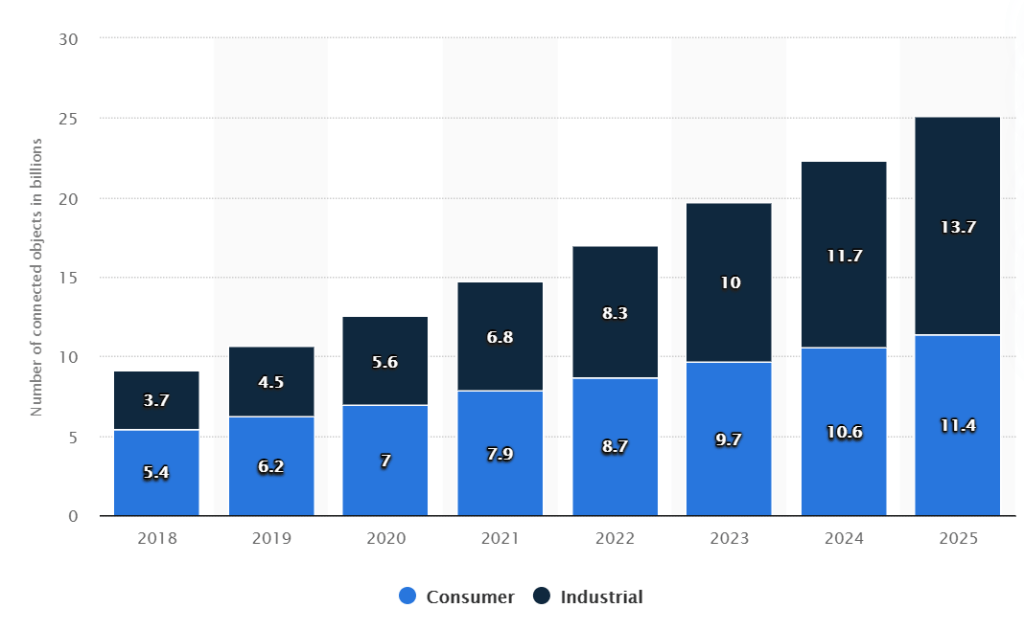
To summarize, IoT market is increasing rapidly. It is expected about 25 billion connected objects worldwide in 2025 following Statista.com information. There is a major opportunity to transform our society and enhance our agricultural sector.

See you then in the next post…

What happens when the cloud adoption is more than that?..do you have a cloud strategy based on your IT profile?

We all think that there are 3 possible stages on your journey to the cloud

Those companies, digital starters, looking for advisory to start moving some workloads to the public cloud from their on premise or private cloud infrastructure. Those companies, called digital expanders, with some experience already on the public cloud and satisfied with the outcome of a first cloud adoption on those projects. Finally, those digital leaders, maybe native or not on the public cloud, but with important investment on OPEX and very focus on the business motivations and the outcomes to be cloud first in almost all they do.

But what happens if we change our perception?..if we think there is a conservative IT profile, a moderate IT profile or even an aggressive one in terms on how to leverage cloud native technologies ?

On one hand, another factor to be evaluated it’s not just how to prepare the cloud adoption with methodologies like CAF. But also to understand that not all the companies need a Data Analytics platform or an IoT solution. At least, during the coming years..

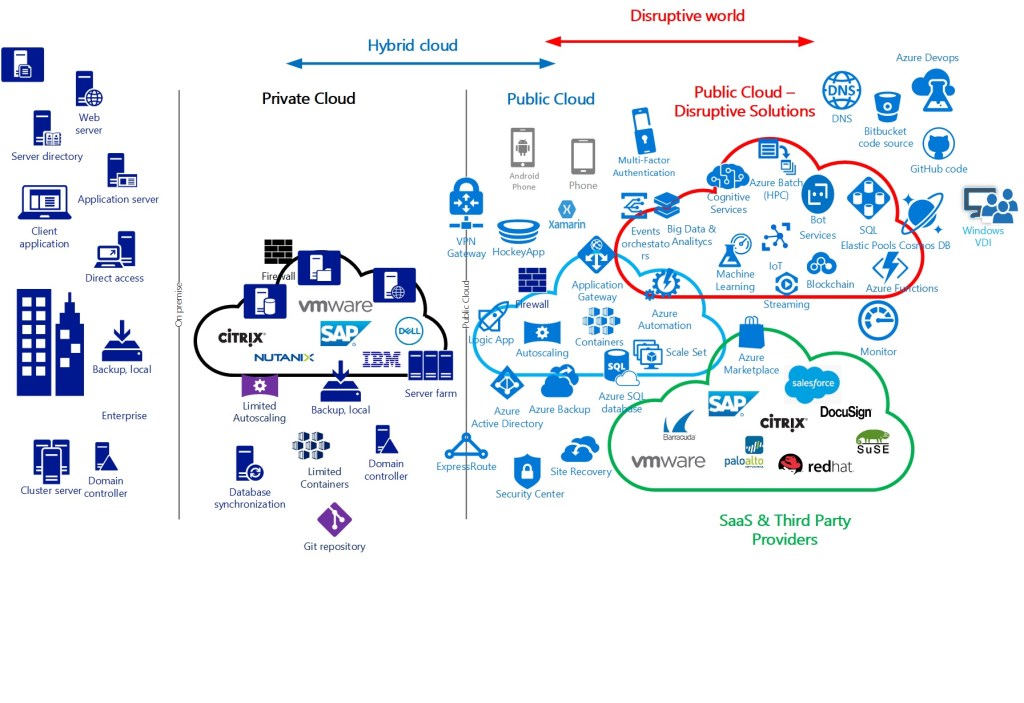
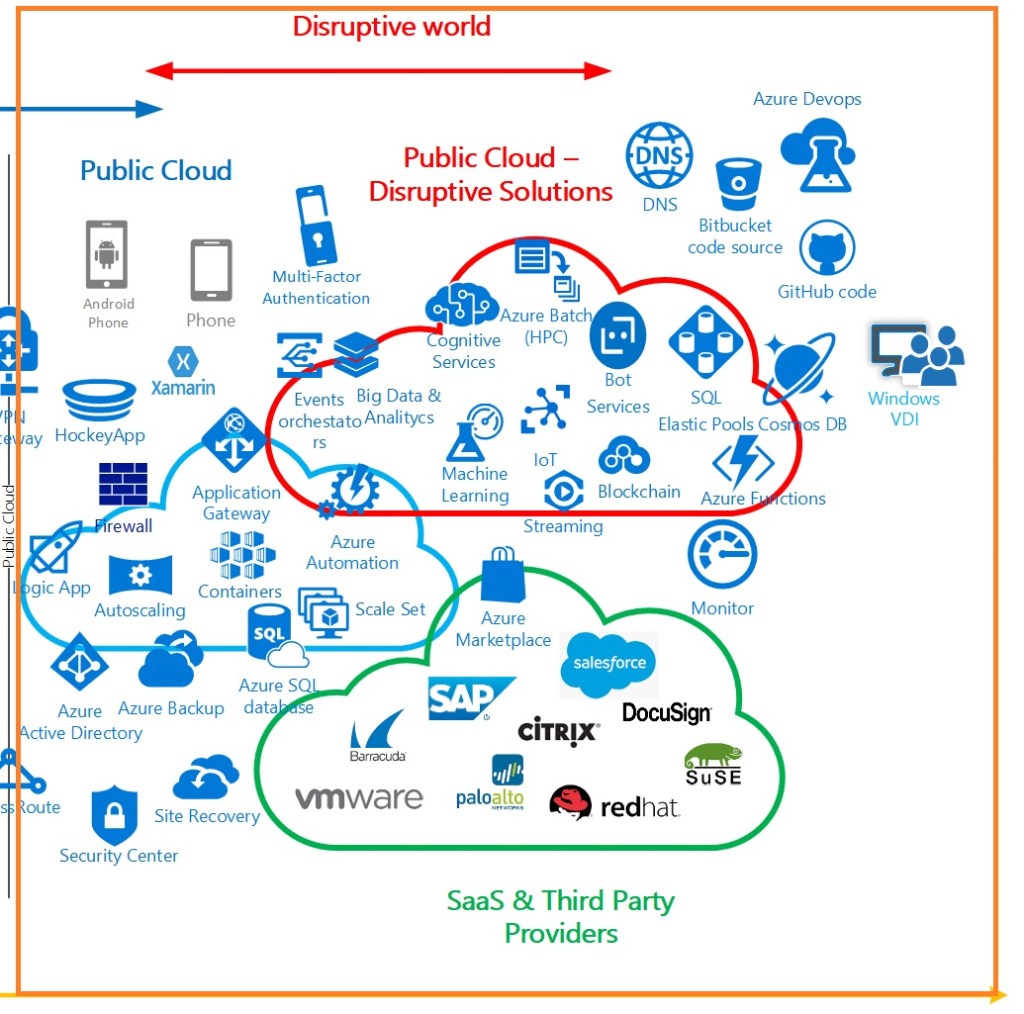
On the other hand, how can you reflect those cloud flavours and the cloud native technologies on the real world?..well we can start with this full picture that came to my head sometime ago..

Depending on your IT profile you will be working on some of these cloud flavours

This picture (based on Microsoft Azure approach) try to represent that there are several technologies that we can group by cloud strategy and associate with an IT profile.

My cloud vision based on technologies and cloud strategies

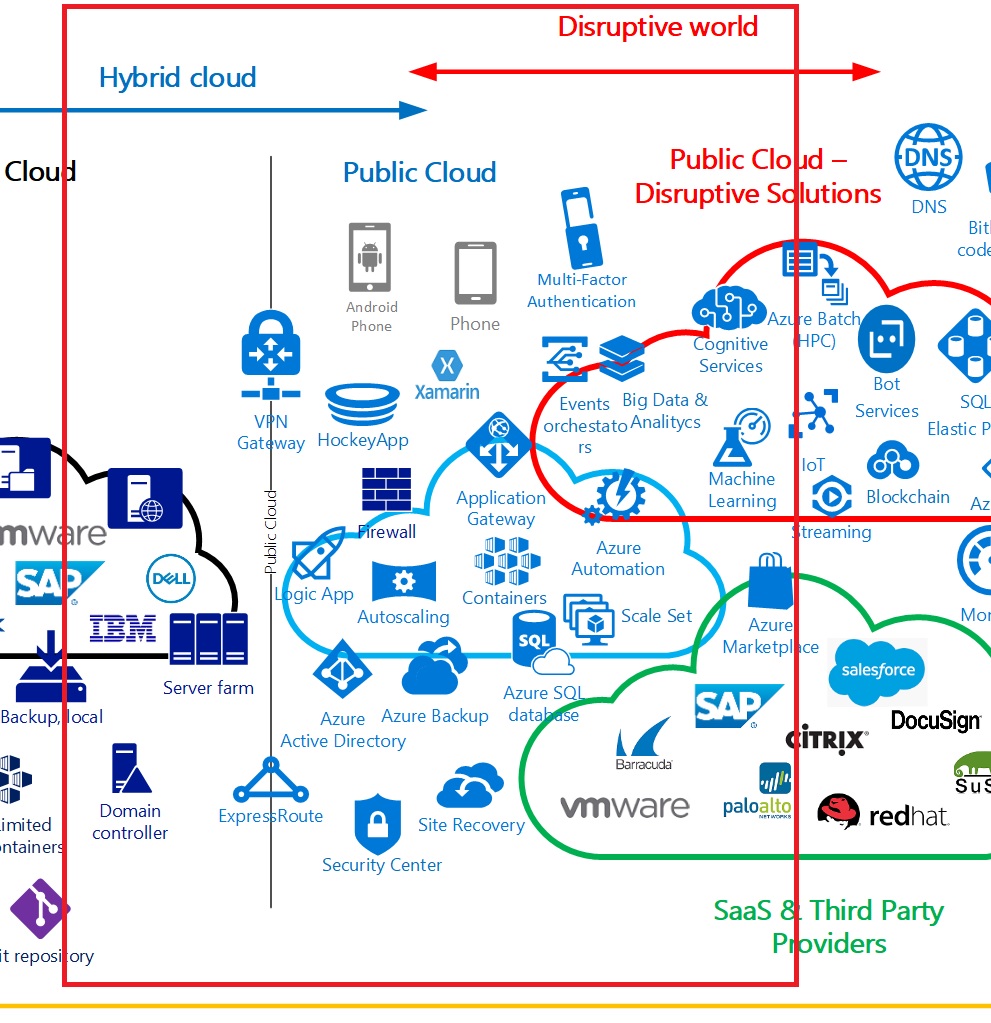
A conservative IT Profile – Would be a company mostly base in traditional infrastructure with storage, backup or archiving as most important priorities as well as some VMs or LOB applications. A sector like banks and finance institutions are well represented here. Actors like hardware providers are still supporting on their on prem and private cloud platforms. Also, they have a big investment on leader hypervisors, complex computing technologies, and use some scalability with containers and autoscale sets but limited for their own resources. User Experience and usability on their APPs is not a strong point and automation on processes with RPA, or use modern Devops platforms is also not very extended on those companies. They have lots of legacy applications and monolithic databases, old data warehouse and traditional ERPs.

Conservative IT Profile

A moderate IT Profile – Would be a company which is more focus on providing an APP or an ecommerce platform with almost no downtime and escalation based on seasonal products. Maybe even they are migrating some specific workloads to bring innovation, to work on a global way with other subsidiaries or to leverage the potential of some disruptive solution like bots to improve the User Experience for their customers. The hardware almost disappear in this kind of companies. They have a hybrid model solution and are starting to embrace the disruption on new cloud native solutions like are cognitive services, machine learning or data analytics. -They are even integrating SaaS technologies like Docusign, use the marketplace to replace some thirty party products that before were present on the previous on premise data center, they had. An example of this profile can be retail companies offering a new online shopping experience, etc.

moderate IT Profile

An aggressive IT Profile – Be cloud first. All they want is working on the public cloud when possible as they learned a lot on the benefits and the outcomes when they CAF and the progressive migration of workloads are well-architected and well defined. They have a tremendous knowledge on leveraging disruptive technologies, save cost, provide the right governance and security and achieve their goals. These companies are very dynamic, use agile methodologies, have clear priorities on accelerate the daily processes, the business and improve the employees and customers experiences. Innovation is their mantra. Here you will see startups like fintech, healthtech,etc. You will see the enterprise vertical on renewable energy companies, insurance or in the chemical and pharmaceutical industry. They use data analytics and Big Data massively, ML, PaaS and Serverless and modern devops platforms. They reduce investment on hardware and licenses as well as integrate SaaS, block chains and other technologies in the daily user experience. Also, they provide APPs and remote work to their users.

Aggressive IT profile

To summarize, this post just try to show that there, outside, adopting the cloud, each company, each public institution have their own hat and they can tailor the technologies to their needs. Finally, not all the companies of each vertical or business are fit with these descriptions but without stereotyping, it is a way of defining types of companies that will soon or later make use of the benefits of the public cloud.

See you then in the next post…